Beginner DSA Lessons Expanded Across the Full Concept Map
DSA Institute now includes beginner-first lessons for every core concept, from Big O and hashing to trees, graphs, dynamic programming, and backtracking.
What Changed
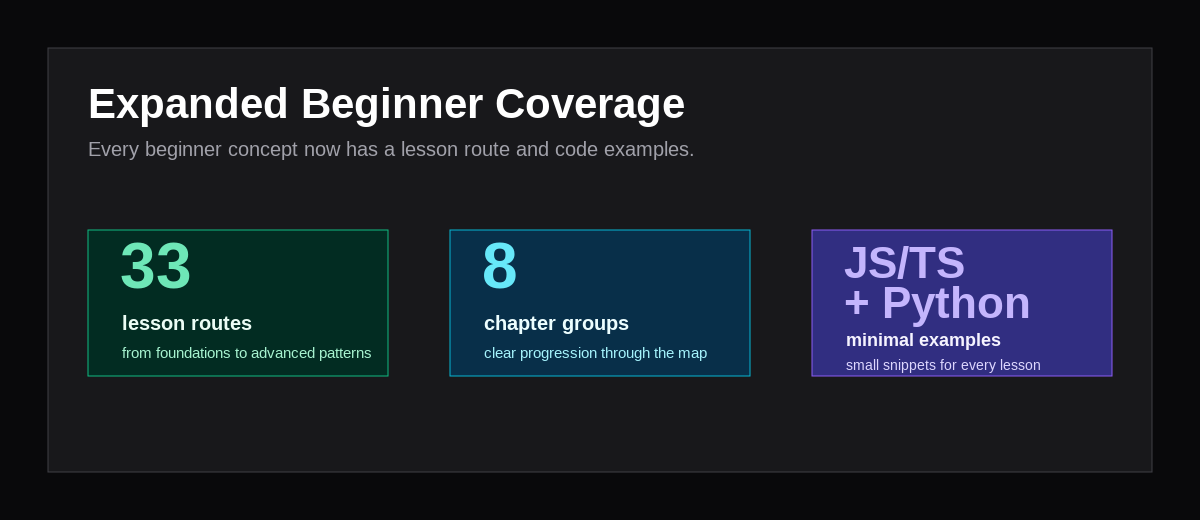
DSA Institute now has a lesson-backed route for every beginner concept in the curriculum. The original visual labs for arrays, linked lists, stacks, queues, and binary search are still present, and the course now continues into a wider beginner map.
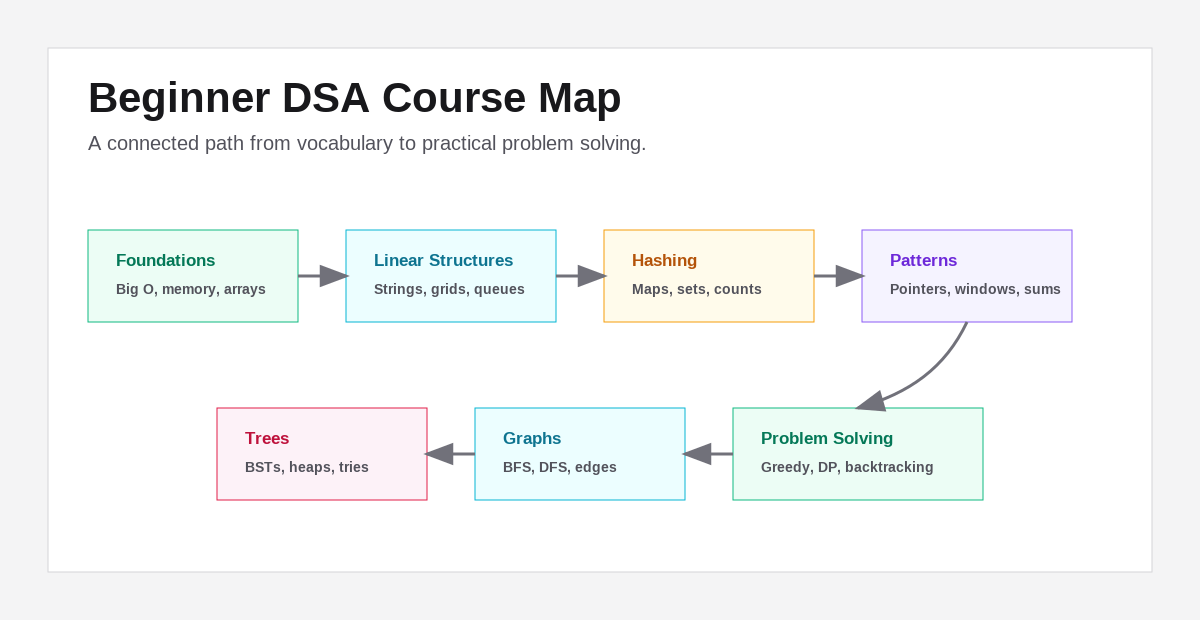
The expanded path includes foundations like Big O notation, memory and references, strings, matrices, hashing, two pointers, sliding windows, prefix sums, recursion, sorting, trees, graphs, greedy thinking, dynamic programming, backtracking, and bit manipulation.
Why It Matters
Beginners often get stuck because DSA topics are taught as isolated tricks. This update connects each concept to the same learning structure: definition, explanation, analogies, practical use cases, small JavaScript/TypeScript and Python examples, pitfalls, and complexity notes.
That consistent shape makes the course easier to scan, easier to revise, and easier to extend with deeper custom visualizers over time.
New Learning Flow
The course now starts with foundations, moves through linear structures and hashing, then builds toward patterns, trees, graphs, and problem-solving strategies.
Each new lesson also appears in the course navigation and sitemap, so learners and search engines can discover the expanded curriculum directly.
Good Starting Points
- Start with Data Structure vs Algorithm if you are brand new.
- Review Big O Notation before comparing solutions.
- Practice Hash Maps and Hash Sets before frequency and lookup problems.
- Learn BFS and DFS before advanced graph algorithms.
- Use Dynamic Programming Thinking when repeated subproblems start appearing.
What Comes Next
The new lessons use a concept-aware visual panel today. Dedicated visualizers can now be added topic by topic without changing the route or content model again.